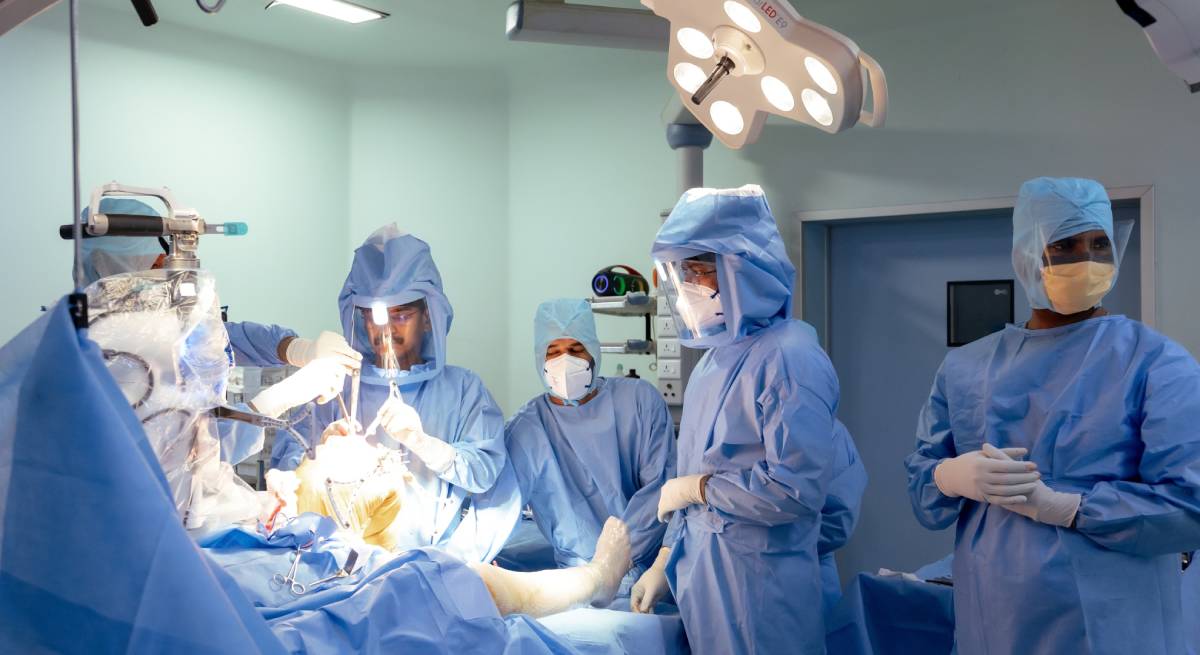
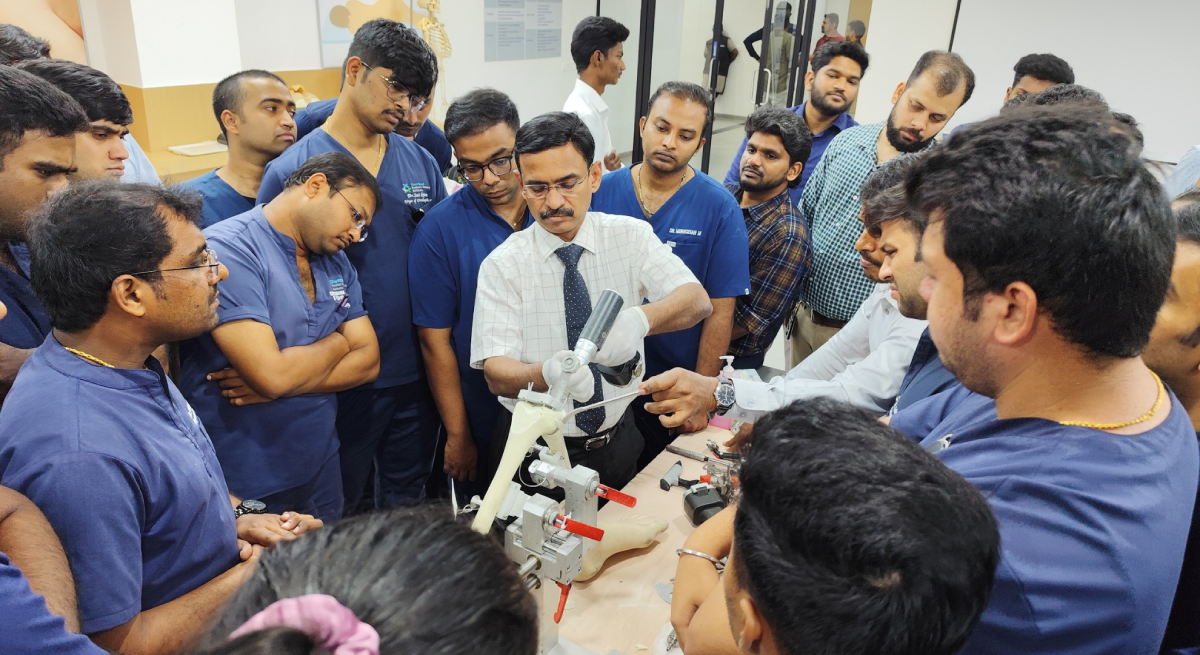
When it comes to total knee replacement, real understanding goes far beyond what textbooks can offer. Recently, Dr. S. Arumugam was invited to Chettinad Hospital : Research Institute to take a workshop on Basic Knee Arthroplasty. What unfolded during this session was not just an academic lecture, but a practical exchange of knowledge shaped by real surgical experience. With around 60 students in attendance, the session reflected how curiosity, clinical exposure, and expert guidance come together to shape future orthopaedic surgeons.
Bridging Theory and Real Surgical Practice
In orthopaedic education, theoretical clarity is essential but it is only the starting point. During the session, Dr. Arumugam introduced the fundamentals of total knee replacement, ensuring that every student understood the purpose, indications, and expected outcomes of the procedure.
However, what made the session stand out was the shift from theory to application. Instead of limiting the discussion to textbook definitions, the focus moved toward how these principles are applied inside the operating room. This approach allowed students to connect knowledge with execution, which is critical in surgical training.
The session highlighted a key idea: understanding total knee replacement is not just about knowing the steps, but about knowing why each step matters.
Understanding the Core of Total Knee Replacement
Total knee replacement is performed to restore function, reduce pain, and improve quality of life for patients with severe knee conditions. While this may sound straightforward, the procedure requires a high level of precision and decision-making.
During the session, key aspects were explained in a simplified yet practical manner:
- The importance of accurate bone preparation
- Correct positioning of the implant
- Maintaining proper limb alignment
- Ensuring joint stability after the procedure
Each of these steps contributes directly to the long-term success of the surgery.
Why Knee Balance Matters More Than Textbook Steps
One of the most valuable insights shared during the session was the concept of achieving a well-balanced knee. This is an area where practical experience plays a crucial role.
A well-balanced knee ensures:
- Smooth and natural joint movement
- Equal tension across ligaments
- Reduced post-surgical complications
- Improved patient satisfaction
Dr. Arumugam who has performed more than 1000+ Robotic knee replacement surgeries emphasized that even if the implant is perfectly placed, an imbalanced knee can affect outcomes. This level of understanding is rarely gained from textbooks alone; it comes from hands-on experience and repeated clinical exposure.
Learning Through Demonstration: The Saw Bone Approach
To make the session more practical and engaging, a demonstration was conducted using a saw bone model. This allowed students to visualize each step of total knee replacement in a structured and clear manner.
Through this demonstration, students were able to:
- Observe the sequence of surgical steps
- Understand how precision affects outcomes
- Learn how alignment and balance are achieved in practice
- Gain confidence in applying theoretical knowledge
This method of teaching created a strong impact, as it bridged the gap between classroom learning and real surgical scenarios.
A Classroom Filled with Curiosity and Energy
The session included around 60 postgraduate students, all of whom showed a strong willingness to learn. Their curiosity was evident through their questions, interactions, and ability to grasp complex ideas quickly.
From a third-person perspective, what stood out most was not just the teaching, but the environment itself. A room full of focused, attentive learners combined with an experienced surgeon sharing real-world insights created a highly effective learning space.
It also highlighted an important truth: future orthopaedic surgeons are being trained not just to perform procedures, but to think critically and adapt to real-life surgical challenges.
An Encouraging Experience for the Students
The students felt happy and encouraged throughout the session. Their active participation, curiosity, and eagerness to interact reflected how much they valued the opportunity to learn directly from an experienced orthopaedic surgeon in Robotic Knee replacement.
Many students felt more confident and inspired after understanding how real surgical decision-making works beyond textbooks. The practical demonstrations and open discussions helped them connect theoretical knowledge with real-world application, making the learning experience more meaningful and engaging.
The session not only strengthened their understanding of total knee replacement but also motivated them in their own journey toward becoming skilled orthopaedic surgeons. The excitement and positive energy in the room clearly showed how impactful the experience was for the students.
Beyond Academics: A Personal Connection
What made this session even more meaningful was its personal significance. The same institution where this teaching session took place is also where Dr. Arumugam’s younger daughter is currently pursuing her undergraduate studies.
Moments like these bring a different dimension to professional experiences. Returning to an academic setting, not as a student but as a mentor, reflects a full-circle journey in medicine. It adds emotional value to an already impactful day.
Key Takeaways from the Session
The session reinforced several important lessons for both students and aspiring surgeons:
- Practical exposure is essential for mastering surgical techniques
- Precision and balance are critical in total knee replacement
- Demonstration-based learning improves understanding significantly
- Curiosity and engagement accelerate the learning process
- Experience plays a key role in translating theory into practice
These insights are not only valuable for medical professionals but also help patients understand the depth of expertise involved in such procedures.
Frequently Asked Questions
What is total knee replacement?
Total knee replacement is a surgical procedure where a damaged knee joint is replaced with an artificial implant to restore function and reduce pain.
Why is knee balance important in total knee replacement?
Knee balance ensures stability, proper movement, and long-term success of the implant. An imbalanced knee can lead to discomfort and complications.
How do surgeons learn total knee replacement techniques?
Surgeons learn through a combination of theoretical study, practical demonstrations, hands-on training, and real surgical experience.
What role do training models play in learning?
Saw bone models help simulate real surgical procedures, allowing students to practice and understand techniques in a controlled environment.
Is total knee replacement a safe procedure?
Yes, when performed by experienced surgeons with proper planning and technique, it is a safe and highly effective procedure.
Conclusion
The teaching session at Chettinad Hospital and Research Institute was more than just an academic interaction—it was a demonstration of how practical orthopaedic knowledge is passed from experience to the next generation. Through structured teaching, real-time demonstration, and active student participation, the session highlighted what truly defines excellence in total knee replacement.
As reflected through the work of Dr. S. Arumugam and the Chennai Ortho team, the focus remains on precision, continuous learning, and delivering better outcomes. It was a day that combined knowledge, experience, and inspiration leaving a lasting impact on everyone involved.